This article was produced with support from the Wayne Barrett Project.
On August 28, Gov. Gavin Newsom sat down behind a desk against a backdrop of American and California state flags, flanked by state patrolmen, to meet the press. Earlier that year, President Donald Trump had sent military troops into Los Angeles to guard against “violence and disorder,” and by late August, Trump had mused that San Francisco was next.
Addressing the phalanx of television cameras, the governor spoke to people’s fears about crime and disorder while refusing to give the president any ammunition in his effort to portray California as lawless under Newsom’s leadership.
He held up a sign reading, “IN CALIFORNIA CRIME IS DOWN,” even as he said, “We are mindful that we have a lot more work to do.”
Newsom had called the press conference to announce an expansion of one of his signature initiatives on crime — the CHP “surge.” The pitch was to deploy officers from the more than 7,000-strong California Highway Patrol, normally tasked with patrolling the state’s massive highway system, to the state’s highest crime cities, saturating communities with their familiar black and white patrol cars.
The operations began in February 2024 in Oakland, which has one of the highest violent crime rates in the country and had suffered what Newsom called an “alarming” increase in violence during the first few years of the pandemic. With the blessing of Oakland’s then mayor, Sheng Thao, he began a series of highly publicized surges, accompanied by regular press releases touting the confiscation of hundreds of firearms, the recovery of thousands of stolen vehicles, and thousands of arrests.
Soon, he expanded the operations to Bakersfield and San Bernardino. Then, sitting before the cameras 18 months in, Newsom pledged to expand the CHP surges to Los Angeles, San Diego, the Central Valley, and Southern California’s Inland Empire, where he wanted to build on the “success of this proven program.”
But what unfolded in Oakland was hardly the bold crime-fighting initiative the governor promoted on television, an investigation by The Oaklandside and Type Investigations has found. In the surge year of 2024, CHP officers averaged one or two assault arrests per month and logged no other violent crime arrests. Instead, CHP officers began ratcheting up traffic stops — disproportionately stopping Black and Latino drivers.
Newsom has decried racial profiling by federal agencies. Last July, he condemned the actions of immigration agents in Los Angeles, saying, “They are violating constitutional rights, terrorizing neighborhoods and businesses, and targeting people because of their skin color and the language they speak.” Yet the CHP’s own data shows that people of color were disproportionately swept up by Newsom’s surge.
The Oaklandside and Type Investigations obtained two years of data capturing more than 38,000 CHP stops in Oakland, brief detentions that usually began with a suspected traffic violation and rarely ended in arrest. We found that in 2023, the year before Newsom’s initiative, the CHP stopped 5,027 Black drivers in the city. That number jumped to 7,461 in 2024, the first year of the surges, a 48% increase. Stops of Latino drivers jumped from 4,820 to 7,748, a 60% increase.
Black people and Latinos each made up around a third of CHP stops during the 2024 surge year, a rate slightly higher than the city’s proportion of Latinos — and far higher than the city’s Black population, at 19%.
“They are racially profiling,” said Philippe Kelly, an organizer with Oakland’s Ella Baker Center for Human Rights, which has campaigned against police misconduct.
The vast majority of people the CHP encountered were warned or ticketed, according to the agency’s data. Yet arrests climbed as CHP touchpoints increased, up 64% for Black people and up 96% — nearly doubling — for Latinos. These encounters can carry special risks for noncitizens.
Driving under the influence was the most common charge. Drug possession and paraphernalia arrests more than doubled. Arrests for auto theft and weapons possession rose, though they remained small in number.
One day last summer, Kelly, who is Black, said he noticed a CHP car trailing him. He suspects the officer ran his plate before peeling off. In the span of 15 minutes, Kelly said a second, and then a third CHP car pulled up behind him. No one initiated a stop, but Kelly said their presence sent his heart racing.
“I was scared to death,” said Kelly. “All of the experiences that I’ve had in the past with police officers in the past have never been good.”
California law explicitly banned racial profiling during police stops a decade ago. The law mandated that law enforcement agencies collect and analyze data about stops in order to identify and eliminate disparities. Since then, data collected by the California Department of Justice shows that across law enforcement agencies around the state, stops of Black people have remained stubbornly high.
“All law enforcement operating in Oakland must be accountable to our community and our values of fairness and equity,” Mayor Barbara Lee said in a response to our findings. “Reported disparities must be examined and addressed.”
The Oaklandside and Type Investigations found evidence that the CHP concentrated its patrols in neighborhoods of color. We mapped a sample of the agency’s stops for the month of June 2024, a total of around 2,000 — a fairly typical monthly tally.
We found a concentration of CHP stops on highways, an indication that the officers were mostly playing their traditional role as highway patrol. The stops that occurred on city streets were clustered in West Oakland, Fruitvale and areas surrounding the Oakland Coliseum — all predominantly Black and Latino neighborhoods. By contrast, wealthier, whiter parts of Oakland, such as Claremont and Montclair, had almost no stops, despite abutting Highway 24 and Route 13.
Of the more than 23,000 CHP stops across Oakland in 2024, the most recent year for which data is available, 1,140 resulted in arrests or misdemeanor citations, just over 5%. Black people made up 36% of those arrests, nearly twice their proportion of the city’s population. Latinos make up around 30% of the city’s population but made up more than 43% of the CHP’s arrests. By contrast, White people experienced 11% of arrests and Asians and Middle Eastern people experienced 7% — less than half their share of Oakland’s population.
Little is known about the CHP’s stops in Oakland beyond 2024, the most recent data published by the California Department of Justice. Because of exclusions in this data set, we relied on the CHP’s more granular data for mapping stops in neighborhoods and were informed by CHP officials that it does not include stops made by officers assigned to outside areas, but who come in to work surges.
Stop numbers for Native American, Pacific Islander, and mixed race individuals were too small to be included in our analysis.
Frankie Ramos, a community organizer who works in the heavily immigrant and Latino community of Fruitvale, described Newsom’s CHP push as a publicity stunt to help lay the groundwork for a potential presidential run. By Newsom’s own estimation, he has held nine or ten press events in the last few years focused on his crime suppression efforts.
“Painting inner cities as crime-ridden and scapegoating immigrants and people of color, it’s an old playbook,” said Ramos, organizing director for Communities United for Restorative Youth Justice. “And it works.”
A Fox News host, responding to the August press conference, said the governor was taking “a page out of President Trump’s playbook.”
At the press conference, Newsom was asked if his planned expansion was a response to Trump’s suggestion that he might send the National Guard to other California cities, after LA. The governor was quick to reject the comparison.
“We’re not reacting and responding to anything, quite the contrary,” he said. “He’s doing things to people, not with people, and so, a point of profound and consequential contrast.”
Few violent crime arrests
Our data analysis revealed one major accomplishment of the surge: hundreds of arrests for driving under the influence, which kills more than 1,300 people a year in the state and has long been a major focus for the CHP. In 2024, CHP officers made 615 DUI arrests in Oakland, up 30% from 2023.
The surge saw an uptick in CHP arrests on other charges, including drug or paraphernalia possession, which more than doubled from 47 in 2023 to 127 in 2024. Arrests for obstruction or resisting an officer nearly quadrupled from 16 to 66. In nine of those 66 chases, obstruction was the only alleged crime.
CHP officers made 267 car theft arrests during 2024 and, though retail theft has remained a hot button issue in Oakland, only six other theft arrests.
Our analysis showed the CHP did little to hold perpetrators of violence accountable. There were 18 arrests for assault or battery in 2024. But not a single person was logged as arrested by the agency for homicide, robbery, or sexual assault during the first surge year.
Diana Crofts-Pelayo, a spokesperson for Newsom, declined to respond in detail to our findings, directing us to his past press conferences and saying only, “The state is proud of its investments in public safety and its key partnerships with local law enforcement agencies to ensure California communities are safer every day.”
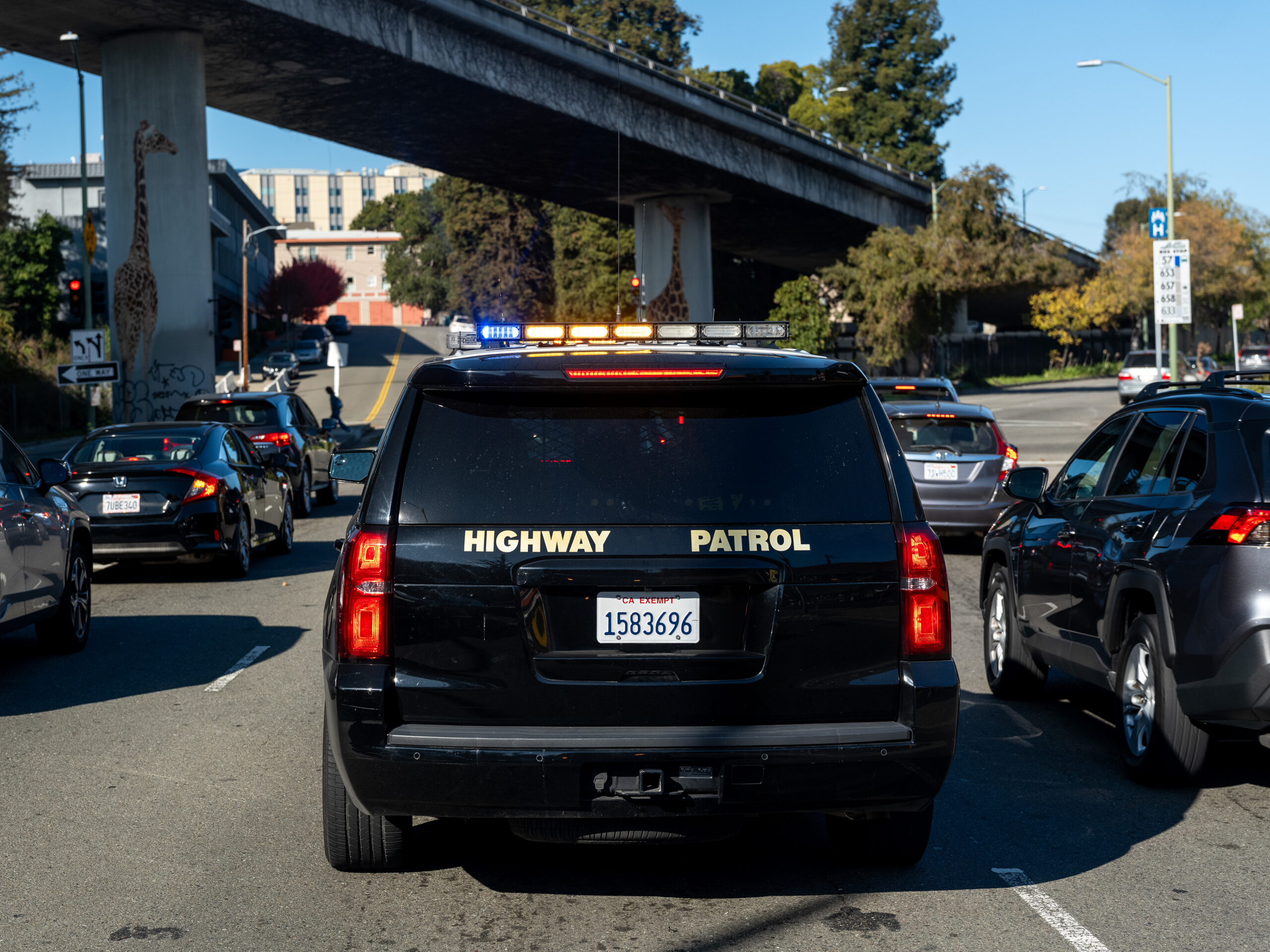
A California Highway Patrol cruiser sits in traffic in Oakland, Calif., on Wednesday, December 10, 2025. Image: Jungho Kim for The Oaklandside
Independent researchers have found disparities in CHP stops in the past. Analysis by The California Policy Lab has repeatedly found that CHP officers disproportionately stop Black drivers. For example, the researchers found that statewide, Black people were stopped by CHP 74% more often than White people in 2019 and noted that the Bay Area had some of the highest disparities in the state.
CHP spokesperson Jaime Coffee said officers base enforcement actions on observed violations, not demographics, and where officers are deployed reflects calls for service and traffic volume. She said neighborhoods were chosen for CHP patrols in coordination with the City of Oakland and the Oakland Police Department.
“We take allegations of racial profiling seriously,” Coffee wrote in an email. “Our focus remains on professional, unbiased policing and maintaining the community’s trust.”
Coffee did not respond to claims that the governor was using CHP resources as a publicity stunt. In response to our findings that CHP officers made very few arrests for violent crimes, she said, “Broadly speaking, efforts to reduce violent crime are not limited to arrests for violent crime.”
“Our visible presence on the highways deters crime,” Coffee wrote. “Highway enforcement is often the first point of contact that uncovers wanted suspects, stolen vehicles, or other signs of violent or organized crime. Even a routine stop can develop into an investigation.”
An embrace by Oakland officials
Alameda County, home to Oakland, Berkeley, and other East Bay cities, saw a sharp uptick in crime during the pandemic, according to data analyzed by the nonprofit Public Policy Institute of California. Violent crimes rose by 39% and property crimes by 28% from 2022 to 2023 — though still remaining below their peaks, which hit highs statewide in the 1980s and 1990s. Similar increases in crime were seen across the U.S.
The first CHP surge operation in Oakland was supported by then-Mayor Sheng Thao, who publicly praised Newsom’s move, calling it “a game-changer in helping us hold more criminals accountable.” Thao, who was recalled last year and is now facing a federal indictment on corruption charges, did not return requests for comment.
Since then, the Oakland Police Department has posted substantial drops in crime, in keeping with a national trend that saw a surge in crime during the pandemic followed by a steep decline. Homicides fell by 32% in 2024 compared to the year prior, and auto thefts dropped at a similar rate. Since President Donald Trump called out Oakland as one of several cities that are “so far gone” due to crime, Lee, who took office in May, has called on the media to “reject these false narratives” about crime in the city.
“Oakland is cleaner and safer,” Lee said in October.
Yet Lee and Oakland City Councilmember Charlene Wang, who chairs the council’s public safety committee, said they continue to welcome the CHP’s support. CHP Sergeant Andrew Barclay, a department spokesperson, told us that takes the form of a surge in Oakland every few weeks or so, during which the state agency sends as many as 40 officers to “proactively patrol” city streets.
Wang said she is especially concerned about ongoing crime in parts of her district, such as Chinatown and Little Saigon.
“It’s pretty frustrating,” Wang said. “Stuff that doesn’t even make the news, and stuff that people are not reporting, because they’re so fed up with getting a nonresponse that they don’t even bother calling.”
An OPD spokesperson responded to queries with a statement saying that the CHP focuses on “Oakland’s High Injury Network, corridors, and intersections with the highest concentration of severe and fatal crashes.” OPD did not respond to a detailed list of questions, including how the department collaborates with the CHP and whether OPD was concerned about our findings of racial disparities in the CHP’s stops and arrests in Oakland.
“We also want to make it clear that the department, the Mayor, the Governor, and CHP are not in competition with one another,” the OPD spokesperson wrote. “Our goal is to work collaboratively to keep our city safe.”
City leaders have long argued that the OPD is woefully shortstaffed, and a September report to the city’s independent police commission found more than 100 officers currently on either medical or administrative leave. Lee has said she wants to see the department expand from 644 officers to 700.
In September, the OPD disbanded its traffic unit, reassigning its six traffic enforcement officers to patrol — and Wang is a proponent of CHP backfilling those roles. Last fiscal year, more than 1,000 people in Oakland were injured in collisions and 45 people were killed, according to a recent OPD report to the City Council.
“ Long term, I do not think that CHP is the solution,” Wang said. “But, I think in the short term, what we’re going to see is a lot more Oaklanders landing in the hospital or families going to funerals related to these traffic incidents. And I don’t think that’s acceptable either.”
Claims with weak foundations
At the August press event, Newsom made some bold claims about his initiative’s success, announcing that the CHP had recovered “over 4,000 vehicles in Oakland alone,” since the beginning of operations 18 months earlier, and in April, he celebrated 170 illicit gun recoveries in the Bay Area in the year since the surges began. He has called these the “tangible results” of the surge.
However, those numbers far exceed the stolen vehicle and weapons arrests in the CHP data we obtained.
Our analysis shows that while the CHP operations nearly doubled weapons arrests and nearly tripled stolen vehicle arrests from 2023 to 2024, the total numbers remained quite small. CHP made 29 weapons-related arrests in Oakland in 2023; in 2024, marked by nearly a full year of CHP surges, the highway patrol made 55 such arrests.
The CHP also ratcheted up stolen vehicle-related arrests, posting 81 in 2023 and 267 in 2024. Still, those arrests are far shy of the 4,000 recovered vehicles Newsom claimed — let alone the 10,439 car thefts reported in Oakland that year.
We asked CHP how the agency arrived at the 4,000 number. Coffee, the CHP spokesperson, said the count includes recoveries from a large swath of the East Bay, not Oakland alone, and includes recoveries by a task force that includes both CHP officers and local law enforcement. She also said those numbers reflect recoveries from a larger time window than the 2024 surge effort.
We submitted a public records request asking the CHP for documentation of the gun and stolen vehicle recoveries Newsom had cited. The agency’s records custodian told us none existed. Coffee later followed up to say that the gun data does exist and was not supplied due to an “unintentional internal error.” The agency had still not provided records at press time.
It’s not the only time the CHP appeared to pad its results. Shortly after the surge began, we asked CHP Lieutenant Matt Gutierrez to clarify the data behind Newsom’s claims about the first surge week, from February 5 to 9, 2024. In a press release, Newsom’s office said the surge had resulted in “the arrest of 71 suspects, the recovery of 145 stolen vehicles, and the seizure of four crime-linked firearms.” Gutierrez said those tallies included arrest numbers from January 22 onward, the date CHP first began assigning officers to the area. That approach added two weeks of data to the five-day surge figures, more than doubling the number of suspects arrested.
When asked about the discrepancy, Coffee said the “CHP’s priority is to report enforcement outcomes transparently and accurately.”
A history of CHP controversy in Oakland
The CHP’s embrace by Oakland’s elected officials hasn’t been shared by the city’s law enforcement watchdogs. Oakland organizers such as Cat Brooks, executive director of the Anti-Police Terror Project, have criticized the CHP for flouting rules Oakland has established to govern law enforcement — especially its restrictions on police chases.
“It’s like the wild, wild west for them,” she said.
For the last decade, Oakland has restricted police car chases to only seriously threatening situations, and requires a pursuit to be terminated if the risk becomes too high for bystanders. Many other large cities, including New York and Atlanta, have similar policies, but Newsom’s office has publicly criticized Oakland’s as “extreme.”
In May, the issue exploded into controversy when CHP officers chased a car through a residential area southeast of Lake Merritt. Marvin Boomer, 39, a public school teacher, was walking with his girlfriend, Nina Woodruff, in Oakland’s San Antonio neighborhood when the fleeing driver crashed into a nearby fire hydrant, which struck and killed him.
Woodruff told The Oaklandside that as she kneeled next to her boyfriend’s body in horror and disbelief, a CHP officer treated her disrespectfully, asking if she’d been in the suspect’s car and demanding that she move away. Though the CHP has said, citing video, that it ended its pursuit before the fatal crash took place, she’s still convinced that the CHP holds some responsibility for his death.
“ A residential neighborhood is no place for a high-speed chase, period,” Woodruff said.
Safe streets advocates saw Boomer’s death as a consequence of the CHP playing by its own rules and demanded an end to Newsom’s surges.
Coffee declined to comment on the circumstances surrounding Boomer’s death citing pending litigation.
Then in October, another CHP chase in Oakland resulted in a collision. When officers sought to pull over a driver for failing to display license plates, the man sped away, according to the CHP. A chase ensued and the driver struck another vehicle, sending it up a sidewalk where witnesses told The Oaklandside it collided with a fire hydrant and destroyed a nearby taco stand.
The CHP had previously come under scrutiny in June 2020, after officers shot Erik Salgado and Brianna Colombo, both 23, while they were traveling in a stolen Dodge Challenger in East Oakland. Plainclothes CHP officers attempted to stop them and then, after Salgado, the driver, struck two cars, fired a barrage of bullets, killing Salgado and striking Colombo several times. Both were unarmed.
The CHP later agreed to pay $7 million to settle a wrongful death suit brought on behalf of Salgado’s mother and the couple’s then 6-year-old daughter.
Benjamin Nisenbaum, one of the family’s attorneys, told The Oaklandside he wasn’t surprised to learn that the CHP had disproportionately stopped Black and Latino motorists, saying, “Of course.”
Nisenbaum, who has litigated multiple police misconduct cases, said that with stepped-up enforcement, officers sometimes rely on implicit bias to guide their stops or concentrate their enforcement efforts on parts of town with more people of color.
“They aren’t surging up in Montclair or…on Piedmont Ave.,” he said.
No structure for accountability
Records show CHP surges in Oakland are not entirely new.
CHP’s partnerships with the OPD go back nearly two decades, at least. According to City Council records, the CHP reported that it had spent $3.28 million in overtime for supplemental patrols in Oakland from 2007 to 2013.
At the time, the police chief argued that short staffing was affecting OPD’s ability to respond to crimes in progress. Data from these past operations mirror aspects of the Newsom surges: a large number of CHP stops in Oakland from November 2012 to early February 2013 — 2,338 — resulted in hundreds of DUI arrests and only 14 gun recoveries. No racial breakdown of the stops or arrests was included in the city council report.
In the two years that followed, from August 2013 through August 2015, the City of Oakland decided to extend the CHP support by covering the costs itself, agreeing to allocate up to $2.6 million for the CHP to deploy a dozen officers, four days a week, in the city. The promise then — as now — was to flood certain neighborhoods with high-visibility patrols and to assist with “gang-related violence and crime.”
The Memorandum of Understanding attached to that report makes clear that Oakland was in charge. Dated May 2013, it lays out that CHP officers will operate under “specific directives” issued by OPD outlining “priority enforcement based on public safety needs.” It emphasizes that “OPD retains jurisdiction,” but on the other hand leaves the CHP in charge of any investigations into claims of wrongdoing by CHP officers.
This is the only MOU between OPD and CHP we were able to obtain, and it does not appear to cover the recent Newsom surges.
The Oaklandside and Type investigations sought collaboration agreements or MOUs from Oakland and every other police and sheriff department in areas named in Newsom’s expansion. None of these local agencies provided one.
The Oaklandside and Type Investigations also requested CHP budget and planning documents related to the recent surge, but the CHP said there was nothing to provide.
Some evidence has surfaced of tension between the agencies.
In April 2024, Capt. Eriberto Perez-Angeles, OPD’s liaison to the CHP, told the Oakland Police Commission, an oversight body, that he had been stonewalled by the agency when he sought details about its car stops. He said CHP responded by handing over some information and then telling Perez-Angeles to file a public records request for the rest.
“It’s frustrating that we can’t have an open line of communication,” said Ricardo Garcia-Acosta, chair of the commission.
Meanwhile, Newsom greatly expanded surveillance in the city, declaring in March 2024, weeks after surges began, that the CHP was installing 480 automated license plate readers in Oakland and the East Bay — an expansion supported by Thao, then Oakland’s mayor.
Brian Hofer was chair of the city’s Privacy Advisory Commission at the time and has long held concerns that data collected by plate readers could be used by outside agencies seeking to arrest immigrants or police reproductive or gender-affirming care.
It’s one reason why Hofer and the commission successfully championed the passage of what the city called the “strongest surveillance ordinance in the country” in 2018 and pushed for a moratorium on license plate readers in the years that followed.
Newsom and the CHP sidelined the privacy commission altogether. Not only did the oversight body have no say in the contract and expansion, Hofer said, but the commission was only invited to weigh on a memorandum of understanding governing the cameras after it had been signed.
Hofer said he believed Newsom was “forcing license plate readers down our throats” to burnish a future presidential bid.
In July, after Trump’s aggressive immigration raids began, the San Francisco Standard reported that both CHP and Oakland police data had been shared with Immigration and Customs Enforcement and other federal agencies.
Hofer resigned in November, frustrated and past his term limit. He and his privacy advocacy organization, Secure Justice, hit the city with a lawsuit days later, accusing Oakland of violating state and local privacy laws due to the plate reader program.
“My biggest concern is that we’re basically building these systems for Trump,” Hofer said. “We’re collecting the data for Trump for any authoritarian to use.”
Coffee, the CHP spokesperson, confirmed by email that there was a “single incident where a CHP Officer accessed the Flock Data System in violation of CHP Policy and State Law.”
“As soon as this was discovered, all CHP employees were retrained, and quarterly audits are performed to ensure no further violations occur,” Coffee said.
She noted that the CHP is not beholden to local watchdogs: “Individual cities forming commissions, advisory councils, etc., are solely within the scope of those cities and not other agencies within the state.”
Garcia-Acosta expressed concern about our findings that the CHP surge has had a disproportionate impact on Black and Latino residents but said there’s little the Police Commission can do.
“We don’t really have any recourse for that,” he said. “We just throw our hands up.”
Future surges
At the August press conference, when Newsom announced that he would expand his “crime suppression” initiative into other parts of the state, Sean Duryee, the CHP commissioner, fleshed out the details. He said the plan was to add teams of 12 to 15 full-time officers in each target city, including Los Angeles, San Diego, and cities in the Central Valley, with the potential to add more officers for specific operations. It was a far cry from the 4,000 National Guards membersTrump sent to Los Angeles last summer or the administration’s 2,000-strong surge of ICE agents sent to Minneapolis in January.
While a dozen officers might make a difference in Oakland, which has less than 700 local police officers, Los Angeles is already policed by about 8,600 LAPD officers and roughly 8,700 sheriff’s deputies.
“Even in a city with large law enforcement agencies,” Coffee, the CHP spokesperson, said, “targeted CHP deployments can make a measurable impact.”
Exactly how dramatic those surges are remains an open question. Coffee, for example, described Bakersfield as “a priority area for CHP’s crime-reduction efforts,” and told us the agency remains active there.
But when we reached out to Sally Selby, a spokesperson for the Bakersfield Police Department, she had a different impression.
Selby said by email that the department did collaborate with CHP investigators during retail theft suppression operations last year. One day in May 2025, for example, a joint CHP team rolled up to a Bakersfield mall, stepping up enforcement for Old Navy, Target, Bath & Body Works, and Macy’s; recovered stolen merchandise worth $1,638; and arrested 13 people, according to a department press release.
That crackdown garnered extensive coverage by local television outlets.
But Selby told us there were no more planned joint operations due to limits on CHP funding. “Apparently, there are three CHP officers assigned to the entire Central Valley, so at this time, they are focused on other communities, not Bakersfield,” Selby said. “We are hopeful that at some point next year, a joint operation can be planned.”
Additional reporting by Ethan Corey.