Every weekday morning outside the 16-story apartment complex at 1400 East-West Highway in Silver Spring, Maryland, students step onto big yellow buses that take them to school. It’s not a particularly pleasant spot: The building faces a fenced-off construction site across six lanes humming with Washington metro-area commuter traffic.
But this is an important place for Montgomery County. In addition to students, the buses are collecting valuable data every time they stick out their stop signs (“stop arms,” in transportation lingo) and flash their red lights. Artificial-intelligence-powered cameras attached to these buses record vehicles that fail to halt—vehicles, in other words, that violate the state law requiring all lanes of traffic to halt for a stopped school bus with its stop arm extended. The footage is sent to local police for review. If they decide the law was broken, the driver receives a $250 ticket in the mail. There are a lot of scofflaws near 1400 East-West Highway. More than 11,500 tickets have been issued here over the past decade, making it among the county’s most heavily ticketed stops.
The county views this as a win-win: Bad drivers get dinged, and the government gets paid. That is how BusPatrol LLC, the company that operates the cameras on Montgomery County’s school buses, presents itself to local officials around the country. In exchange for a portion of citation revenue, it plugs in the cameras, records the violations, bundles up the evidence and mails tickets after police review. BusPatrol started operating in Montgomery County in 2017. At the time, local police assured residents that violations would subside as drivers learned their lesson.
Yet critics of BusPatrol say municipalities are getting a bad deal. In Montgomery County, after more than 375,000 tickets and $92 million in issued fines, there’s been little reduction in violations and no evidence of a decline in collisions near stopped school buses, according to county records and Bloomberg Businessweek’s review of local news reports and stop-arm camera footage. The county has done little to change the infrastructure at its most ticketed stops; it’s repeatedly said there are no safety concerns at most of these locations. Because of the financial structure of the program, the county transferred millions to its stop-arm technology providers for the first three years and kept no revenue itself, while also spending hundreds of thousands of tax dollars to review the AI’s work. Meanwhile, there’s evidence the program is heavily burdening residents who either can’t or don’t pay the fines.
BusPatrol has attached its cameras to about 35,000 buses in 24 US states and more than 350 school districts. Public records Businessweek obtained show that, because of their contracts with BusPatrol, many local agencies have spent years effectively acting as revenue generators for a for-profit company, ticketing thousands of drivers and sending most of the funds back to BusPatrol. Citations often remain high year after year, despite the company’s promises they will decline. Municipalities can wind up keeping very little money from their partnerships because of the company’s high monthly technology fees.
Montgomery County Vision Zero Coordinator Wade Holland defended the partnership, noting that the illegal passing of stopped school buses is a national problem. “By having a school bus arm monitoring program, Montgomery County is able to hold drivers accountable, educate drivers about their responsibilities around a stopped school bus, and have another data source to understand what is happening when our students are getting picked up or dropped off,” he said in a statement. The Montgomery County Police Department declined Businessweek’s request for an interview, pointing instead to the county’s annual reports on the BusPatrol program.
In a statement, BusPatrol spokesperson Kate Spree said the company’s services “provide school districts with critical safety technology and enforcement support at no cost to taxpayers or law-abiding drivers, helping communities protect students traveling to and from school.” BusPatrol said it works with municipalities to establish financial structures that allow the company to recoup its upfront investment and operating costs. In many cases, it said, the cost of operating cameras can equal or exceed violation revenue, but that in the latter scenario, the company covers the gap. It also pointed to a recent report on school bus safety by the Governors Highway Safety Association that recommends stop-arm cameras as a solution.

Illustration by Brown Bird Design; Source: FY 2025 School Bus Monitoring System Report, Montgomery County
BusPatrol is growing quickly. By early 2024, private equity firm GI Partners had made a significant investment in the company, reportedly acquiring a majority stake in the process; Weatherford Capital also announced a strategic investment later that year. BusPatrol said in a blog post that it made more than 250 new hires and added school districts in Florida, Michigan, Texas and Virginia to its client base in 2025.
The expansion is driven in part by America’s epidemic of pedestrian deaths. BusPatrol promises local officials it can solve a problem at no cost to the government, an appealing combination for leaders faced with shrinking budgets and public pressure to address safety concerns. Instead, “it’s a tax with no payoff,” says Tim Curry, policy and research director at the Fines & Fees Justice Center, which advocates for financial penalty reform in the US criminal justice system. “It allows communities to say, ‘Look, we take safety seriously’ without actually taking safety seriously, and the private company profits hand over fist.”
For David Moon, a member of the Maryland House of Delegates who’s spent years trying to reform the program in Montgomery County with little success, the situation emphasizes the importance of preventing profit motives from overtaking the public interest. “The minute you ask a question about stop-arm safety enforcement, you’re immediately going to get tagged as trying to harm the children, or not caring about the children’s safety,” he says. “All hell broke loose when you tried to touch the money.”
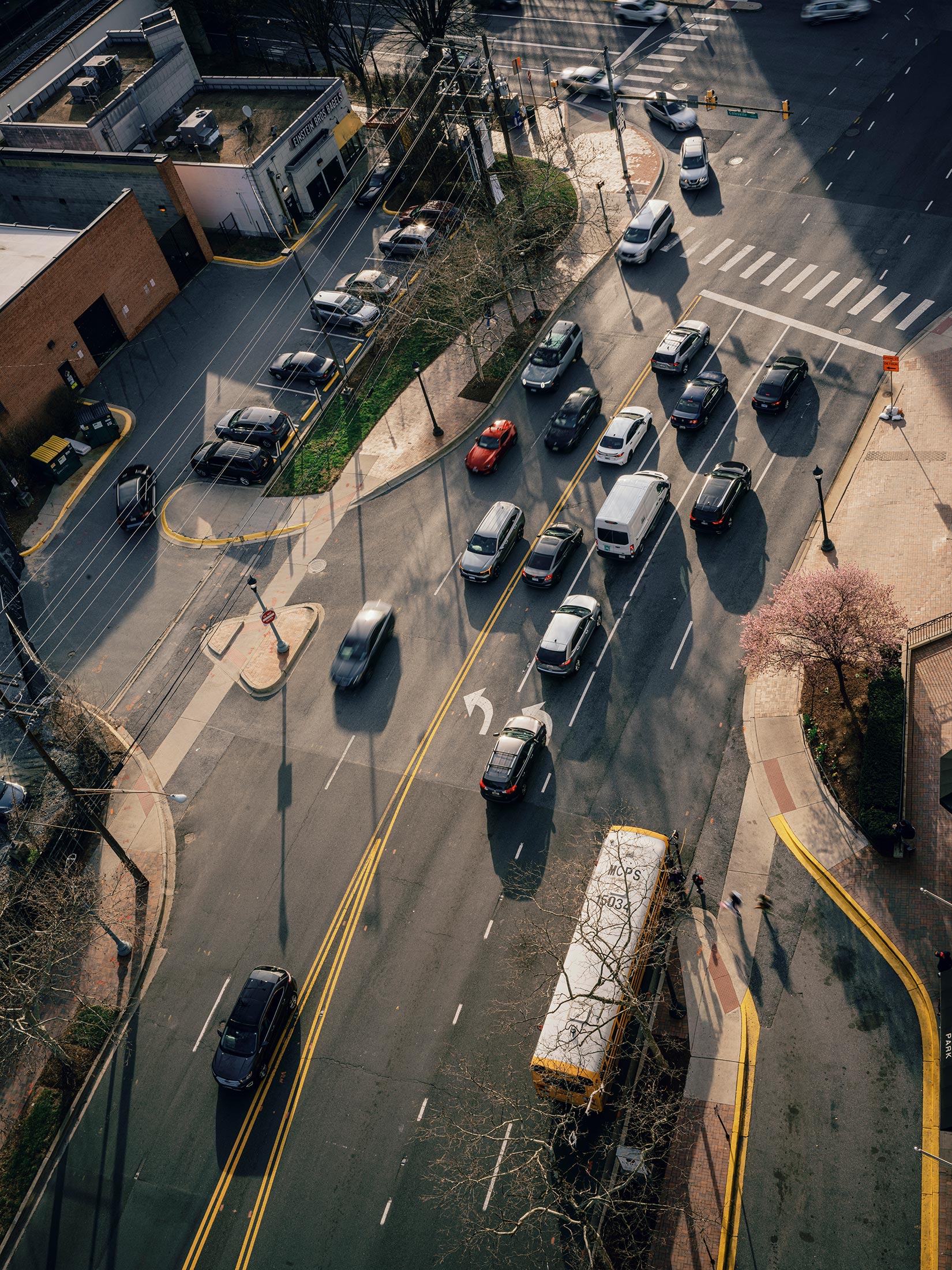
Image: Greg Kahn for Bloomberg Businessweek
BusPatrol grew in the wake of a massive public corruption scandal involving another school bus stop-arm tech company. Founded in 2009, Louisiana-based Force Multiplier Solutions Inc. had a model that was similar to what BusPatrol later became: It installed traffic cameras on school bus fleets free of charge, using citation revenue to recoup the costs.
In 2015 a group of Montgomery County officials traveled to see FMS’s technology in action in Dallas County, Texas, which was one of FMS’s marquee clients. They left impressed by the company. “Their business model, while it seems a little too good to be true and all that, it works for them,” Richard Hetherington, then the automated traffic enforcement unit manager for Montgomery County’s police department, said at the time. In 2016, Montgomery County signed up to mount FMS cameras on its own yellow fleet. “This is all about the protection of the kids both inside and outside the bus,” Hetherington said.
But FMS was actually in deep trouble. In 2017 local news reports uncovered evidence of an alleged bribery and kickback scheme between FMS and officials at Dallas County’s school bus transportation agency, which had fallen deep into debt because of the program. Infuriated Dallas residents voted to dissolve the agency, while FMS sold off its assets. The buyer was BusPatrol, which was founded in 2017 by a Montreal entrepreneur named Jean Souliere. BusPatrol began servicing some of FMS’s existing contracts, including Montgomery County’s, later that year. (In 2018, FMS Chief Executive Officer Robert Leonard pleaded guilty to federal conspiracy charges stemming from the company’s relationship with Dallas County. Rick Sorrells, the agency’s superintendent who personally showed Montgomery County officials around, pleaded guilty to charges of wire fraud and was forced to forfeit a Maserati, a Porsche and a $16,400 custom gold bracelet with diamonds. Both men eventually went to prison. Businessweek was unable to reach Leonard or Sorrells for comment.)
Soon, Montgomery County drivers were questioning the value of their own government’s partnership with BusPatrol. By mid-2019, the county hadn’t kept any revenue from the tens of thousands of tickets it had issued since 2016. Instead, it had transferred almost $21 million to BusPatrol (and FMS before it) to pay to install the cameras, 10% more than the company had initially estimated, according to an audit by the Maryland General Assembly. A separate audit by the county inspector general’s office found the county had spent another $750,000 on its administrative and personnel costs related to citation reviews. As for the program’s effects on drivers, the county audit drew this conclusion: “We were unable to find any evidence of a decrease in collisions, improved public safety, or a reduction in total violations from this program.”
The revelations prompted a revised agreement with BusPatrol that ensured the county would start keeping some of its revenue; from fiscal year 2019 to 2024, the county kept about $18.5 million from collected fines and set aside roughly $40 million for BusPatrol. But citations have only modestly declined in that time. In 2020 the county issued 36 citations per active camera, or 50,698 citations total. In 2025 the county issued 34 citations per camera, or 51,779 total. And at least three children have been struck by motorists while getting on or off stopped school buses in Montgomery County since 2017, according to Businessweek’s review of local news reports and stop-arm camera footage. The county audit found no evidence of any such collisions in the five years before the stop-arm program began.
Montgomery County officials didn’t respond to Businessweek’s questions about collisions since 2017. BusPatrol said that industry statistics show the vast majority of drivers who receive violations do not reoffend.
Meanwhile, some of the program’s local boosters have benefited. In 2021, Hetherington took a job as BusPatrol’s director of program management. Later that year another employee of the county’s automated traffic enforcement unit left and joined BusPatrol soon after. According to Montgomery County Ethics Commission records, Hetherington agreed to pay $2,500 to the county to resolve potential ethics issues stemming from rules that require employees to wait a year before taking jobs with businesses they’d worked with in a government capacity. Both Hetherington and his former colleague promised they wouldn’t work on BusPatrol contract matters in the county. (BusPatrol said it hasn’t employed Hetherington for many years. Businessweek was unable to reach him for comment.)

Image: Greg Kahn for Bloomberg Businessweek
Montgomery County’s steady stream of stop-arm violations stems largely from one problem: Drivers seem unsure or unaware of what to do when buses are traveling in the opposite lane. The school bus stop at 1400 East-West Highway exemplifies drivers’ confusion, says Moon, the state delegate, standing on the side of the road as traffic whooshes by. It’s right off the highway’s intersection with Colesville Road, a seven-lane thoroughfare with raised medians. In Maryland, drivers traveling in the opposite direction of buses are not required to stop if the roadway is separated by a physical median.
But East-West Highway has two turn lanes, or what Moon calls “a paint illusion,” in which “a median is suggested.” Here, without a true median, it’s illegal to pass the stopped bus, regardless of what lane you’re in, but it’s easy to miss the difference. Many of Montgomery County’s most ticketed stops have these false medians, in addition to wide, congested roads and four-way intersections that Moon says can make it hard for drivers to spot buses stopped across several lanes of traffic. In fiscal year 2025 some 89% of all stop-arm tickets issued at the county’s top-10 citation locations were for opposite-lane violations. “You’re dealing with a very congested urban environment with lots of changes,” Moon says. “There’s just infinite numbers of drivers on these commuter thoroughfares to replenish the people that are getting the first wave of tickets.”
There’s also an education gap. In a 2024 survey of US drivers’ knowledge of school bus stop-arm laws, the National Highway Traffic Safety Administration found the vast majority of respondents knew how to behave when moving in the same direction as the bus. But thanks to “vague and varying State laws,” drivers answered incorrectly roughly half the time when asked about opposite-lane scenarios with no median. Less than 1 out of 5 drivers knew what to do when overtaking a school bus on a four-lane road with a median. In Montgomery County, even school bus drivers themselves seem perplexed: From 2015 to 2023, they were cited more than 300 times for passing each other, according to another investigation by the county inspector general.
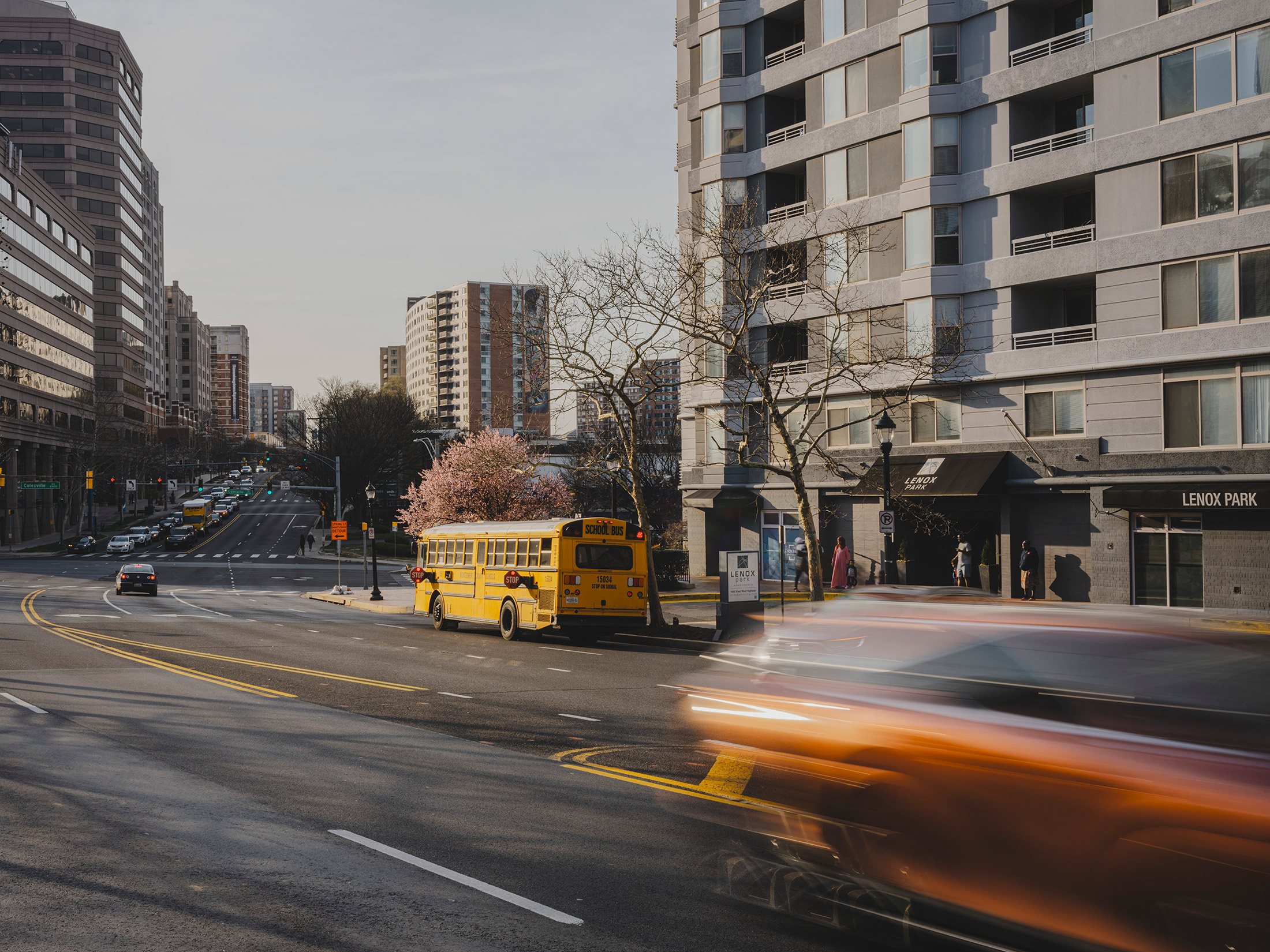
1400 East-West Highway in Silver Spring has one of the most ticketed school bus stops in Montgomery County. Image: Greg Kahn for Bloomberg Businessweek
The cost of this confusion can snowball for residents who can’t pay. In Maryland the state blocks drivers from renewing their vehicle registrations if they don’t pay stop-arm citations. In Montgomery County, there were 50 of these so-called registration flags for these citations in the three years leading up to its BusPatrol partnership. In the years since, there have been more than 31,000.
For years, Moon has been trying to reform the BusPatrol partnership so it better aligns with the county’s Vision Zero plan, which calls for ending serious and fatal car crashes through infrastructure fixes, educational campaigns and targeted enforcement. In 2022 a bill he sponsored requiring the county to annually report citation numbers and other data from the stop-arm program became law. Four years of these reports revealed to Moon that the county’s 10 most ticketed stops have remained largely the same.
But Moon’s subsequent proposals—such as giving warnings to first-time opposite-lane offenders on certain multi-lane roads and earmarking ticket revenue for infrastructure improvements, a practice widely encouraged by safety advocates—have met resistance. Steve Randazzo, BusPatrol’s chief growth officer, has said Moon’s first-time warning legislation would put “students at risk.” (BusPatrol said it recommends that municipalities warn drivers before stop-arm programs go live with ticketing.) Sarah Sample, associate policy director for the Maryland Association of Counties, added the warnings could “leave the window open” for drivers to continue breaking the law.
But if safety were truly the priority, Moon says, officials would move the most ticketed bus stops and install more medians on multi-lane roads. The county has repeatedly said in its annual reports that it’s found no safety concerns at most of its most ticketed bus stops, including the one on East-West Highway. For Moon, this exemplifies what he sees as the perverse incentives driving the program: The county tickets thousands of drivers at locations its own experts consider low-risk, but safety still hasn’t demonstrably improved. “You’ve got to bang your head against the wall sometimes,” he says.
Holland, the Vision Zero coordinator, says the county has improved safety at some bus stops by repainting crosswalks, adding reflective materials and fixing signal equipment. He says that even though most stops are deemed low-risk, “school bus cameras serve as an additional safety and driver accountability measure” and that moving bus stops could increase safety risks to students.
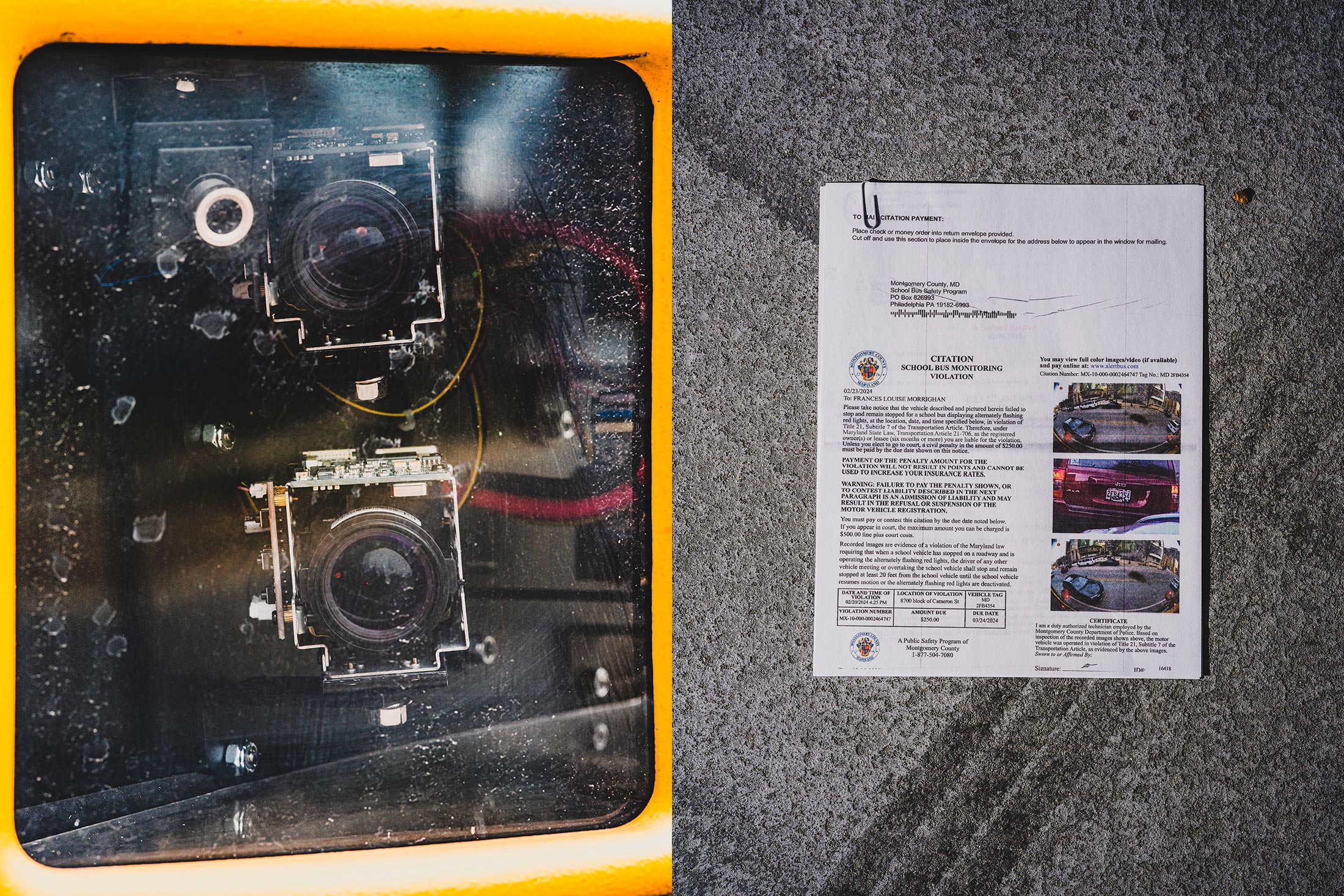
Cameras and sensors on Montgomery County school buses and the ticket issued to Frances Morrighan, a Montgomery County resident. A judge found Morrighan liable only for court costs, not the fine, agreeing that her view of the bus had been obstructed. Image: Greg Kahn for Bloomberg Businessweek
Similar patterns are playing out in several US communities, complicating BusPatrol’s claims that its technology reduces infractions year over year. Businessweek obtained year-over-year stop-arm citation totals from 17 government agencies that team with BusPatrol. In seven of those municipalities, per-bus citations have increased in the years since the partnerships began. In another 3 of the 17, total citation levels were up, but the programs were either very new or the municipalities didn’t provide data on a per-camera basis, making a comparison difficult. Three others saw per-bus citations decline, and four saw total citations decline.
In at least two of the locations where citations have gone down, the municipalities have done more than simply install stop-arm cameras. In Suffolk County, New York, which announced its BusPatrol partnership in 2020, a local law requires that 20% of ticket revenue is spent on safety awareness initiatives. There, an extensive education campaign has helped bring citation totals down more than 35% over three years, according to county reports. Howard County, Maryland, has spent its share of citation revenue on public safety projects and an educational campaign. Total citations there declined 12% from 2022 to 2024, county records show. (BusPatrol also pointed to a survey by the National Association of State Directors of Pupil Transportation Services, a trade group, in which a sample of school bus drivers reported a decline in illegal passings in 2025, the first time since 2011.)
BusPatrol’s revenue splits with its government partners vary. Many contracts stipulate that BusPatrol will receive 60% of citation revenue, with the municipality getting the other 40%. But in many cases, municipalities must first pay off the company’s monthly “technology fees,” which run as high as $400 per bus, substantially reducing their portion of revenue. The agreement that Richmond, Virginia, has with BusPatrol lays out a 40% net revenue share for the city. Yet after paying $37,800 in fees each month, the city was left with 11% of total citation revenue, or about $499,000, out of the school years from 2021 to 2024, public records show. (BusPatrol said that its fees can be higher when municipalities add on bus-tracking software and other services in addition to its cameras.)
Again, some jurisdictions have gotten better deals than others. In Florida, the board for Miami-Dade County Public Schools negotiated a contract that guaranteed the district 30% of gross revenue from the beginning of the BusPatrol partnership in 2024, with no charge for technology fees, according to a school district audit of the program. It earned the county almost $6 million in half a year. (In April 2025 the Miami-Dade Sheriff’s Office suspended the program because of enforcement errors that it blamed on BusPatrol. At the time, BusPatrol said it was committed to working with stakeholders to restart “this critical student safety program.” The program remains suspended.)
BusPatrol also says its AI-powered cameras catch passing drivers better than people can. But in 6 of the 15 communities that provided Businessweek with data, human reviewers are tossing out a growing share of the potential infractions the cameras capture. Wayne Coats, the sheriff of Harnett County, North Carolina, spent five years overseeing officers who reviewed BusPatrol’s stop-arm citations. He recalls watching videos of drivers who risked being rear-ended if they’d stopped for the school bus. When his team threw out those citations, BusPatrol “was not happy with me about it,” he says. “They thought every picture they took had to be a civil penalty.” (BusPatrol said that although its system is designed to capture potential technical violations, law enforcement agencies have sole discretion over whether to issue citations, and all drivers can contest their tickets.)
Jay Beeber, the executive director of policy for the National Motorists Association, a driver advocacy group, notes that fatal collisions involving illegal school bus passes are extremely unusual. A 2024-25 survey conducted by the Kansas State Department of Education found there were 1,279 student fatalities related to the loading or unloading of school buses in the preceding 55 years. In 57% of those cases, the vehicle involved was a school bus. School bus industry estimates count about 10 billion student rides annually.
BusPatrol said that illegal school-bus passings are frequently under-recorded and that official data doesn’t capture near misses. Many government bodies and traffic safety experts recognize illegal passings by motorists as a safety issue, it said. “BusPatrol is a mission-driven organization devoted to addressing the national epidemic of school bus stop-arm violations that endanger our children every day across this country,” Spree, the company’s spokesperson, said in a statement.

Image: Greg Kahn for Bloomberg Businessweek
After falling for decades, annual pedestrian deaths in the US surged 70% from 2010 to 2023. This heightened danger has prompted action from state and local governments across the US, including Montgomery County, which was one of the first to adopt a Vision Zero plan and has spent millions on new bike lanes, crosswalks and public awareness campaigns, including one about school bus stop-arm laws. Yet serious and fatal crashes involving pedestrians are up 45% since Vision Zero began.
Although interventions are clearly needed, the revenue-sharing model used by BusPatrol and other automated traffic enforcement technology companies prioritizes the wrong thing, says Molly Kleinman, the managing director of the Science, Technology and Public Policy program at the University of Michigan’s Gerald R. Ford School of Public Policy: “They want you to configure your system in a way that maximizes revenue, which is not necessarily one that is concerned with things like equity and safety.” That’s why many policy experts discourage local governments from splitting revenue with vendors, advocating instead for protective street designs as a first precaution.
Some local leaders are calling their BusPatrol partnerships into question. Harnett County terminated its program in 2025 because of cost concerns. A Pennsylvania state senator, hoping to fix what she calls a “ridiculous” and “broken” stop-arm ticketing system, has introduced legislation to reduce fines and streamline the appeals process. After Miami suspended its BusPatrol partnership, a school district audit found that BusPatrol issued citations to drivers even after law enforcement voided the charges. (BusPatrol objected to those findings.)
Moon recently secured a modest victory. In 2024 a bill he authored was signed into law, forcing Montgomery County to move most of the bus stops that are currently on roads with five or more undivided lanes without a traffic signal or crossing guard. But the law won’t go into effect until 2029, and it only addresses stops that have netted 400 or more opposite-lane violations in the previous fiscal year. He still hasn’t succeeded in reducing fines or getting the county to earmark the revenue to invest in new infrastructure. Still, there may be other changes coming to Montgomery County’s program: On March 31 the county issued a request for proposals from new school bus stop-arm camera vendors.
For now, the only recourse residents who feel they have been unfairly cited have is to protest their tickets in court. On a scorching afternoon last July, Frances Morrighan took unpaid time off from her job teaching kindergarten in Washington, DC, to plead “guilty with explanation” to a ticket she’d received more than a year earlier. She was one of dozens who showed up to contest their alleged stop-arm infractions that day. “I’ve got 99 cases here,” Judge Holly David Reed III said as he settled behind a dais in Rockville, Maryland, and gestured at a foot-high stack of manila folders. After reviewing Morrighan’s footage on a large-screen TV, Reed ruled she was liable only for court costs, not the fine, agreeing that her view of the bus had been obstructed.
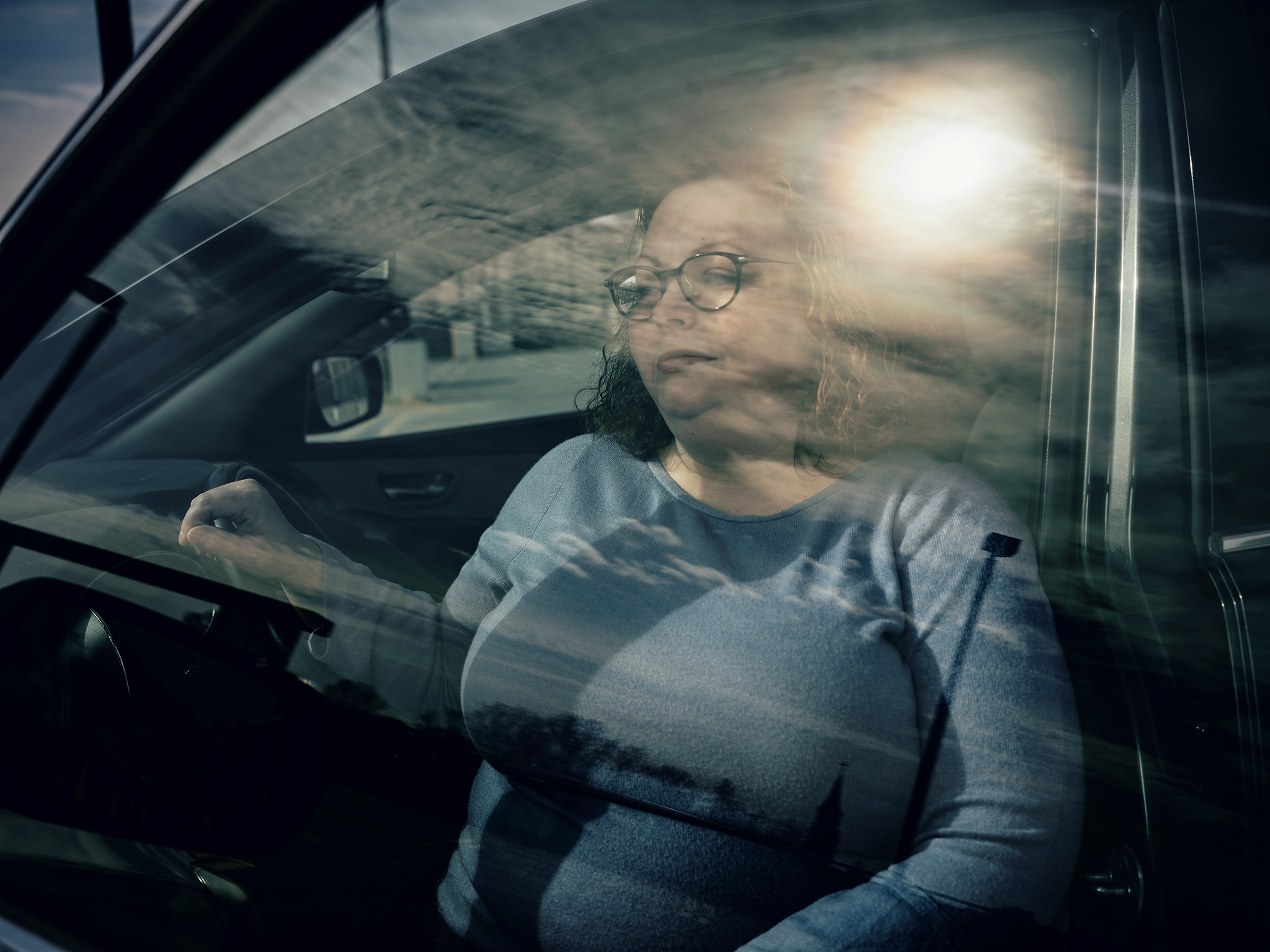
Morrighan. Image: Greg Kahn for Bloomberg Businessweek
The hearings stretched on for almost three hours as residents fanned themselves with their tickets and murmured obscenities. Reed watched dozens of other allegedly illegal passes. In every case, he either reduced the fine or canceled it entirely, deciding that drivers couldn’t have stopped in time, were confused by the road design or simply weren’t endangering anyone. Morrighan was relieved by the outcome, but perplexed by the exercise. “It’s a waste of the court’s time, a waste of the facilities and a waste of the taxpayers’ time,” she says. “It feels like you’re being mugged instead of educated.”