This project was produced in partnership with Hell Gate, with support from the Wayne Barrett Project.
Judges wield enormous power. Here in the five boroughs, they are often the ultimate arbiters in deciding how many New Yorkers get sent to Rikers Island, where and how new housing will be built, and when children are removed from their families.
You might assume that these judges, whether they are appointed to the bench or elected by voters, have been deeply vetted, earning their positions via their qualifications and merits.
But this is far from the reality.
In 2008, Supreme Court Justice John Paul Stevens famously described New York’s method of selecting judges for its higher trial courts as “stupid.” We concur, your honor! In New York’s unique system, candidates for State Supreme Court are picked at conventions run by county political parties—an exercise that is susceptible to corruption and patronage politics, and leads to elections that have the veneer of democracy but in truth are often decided in back rooms by only a few party insiders. Other judges are appointed by the mayor or shifted around by the state’s court system via an opaque process. (One programming note: Judges on State Supreme Court are technically known as “justices,” unlike those on lower courts. To avoid unnecessary confusion, we’re referring to all members of the judiciary as “judges.”)
Why do we do it this way? The short answer: New York City’s long history of graft, the foundation upon which our beautiful city is built. But here’s the long answer, courtesy of Hell Gate and Type Investigations: Courts of Contempt, our in-depth inquiry into how people become judges in New York City; the scandalous nature of the county political parties that often subvert democracy to get their favorite attorneys on the bench; and the reform efforts to try to finally fix the city’s judiciary.
Also included in Courts of Contempt: profiles of nine judges who embody aspects of this broken system. These judges are all far from perfect, although their faults are not entirely their fault—this is the result of a system where corruption runs rampant and oversight is insufficient, and where efforts at reform have run up against the shores of cronyism.
You’ll read about judges appointed or elected to serve on one court, only to be shifted to another, without any transparency; judges who flout the spirit and intent of the state’s 2019 bail reforms; former prosecutors with reversed convictions and reduced sentences; and plenty of bad behavior and ignorance of the law—with regular New Yorkers paying the price.
We reached out to the Office of Court Administration, the body that runs the state’s court system, multiple times via email and phone with a detailed list of questions. Unfortunately, OCA did not provide any answers.
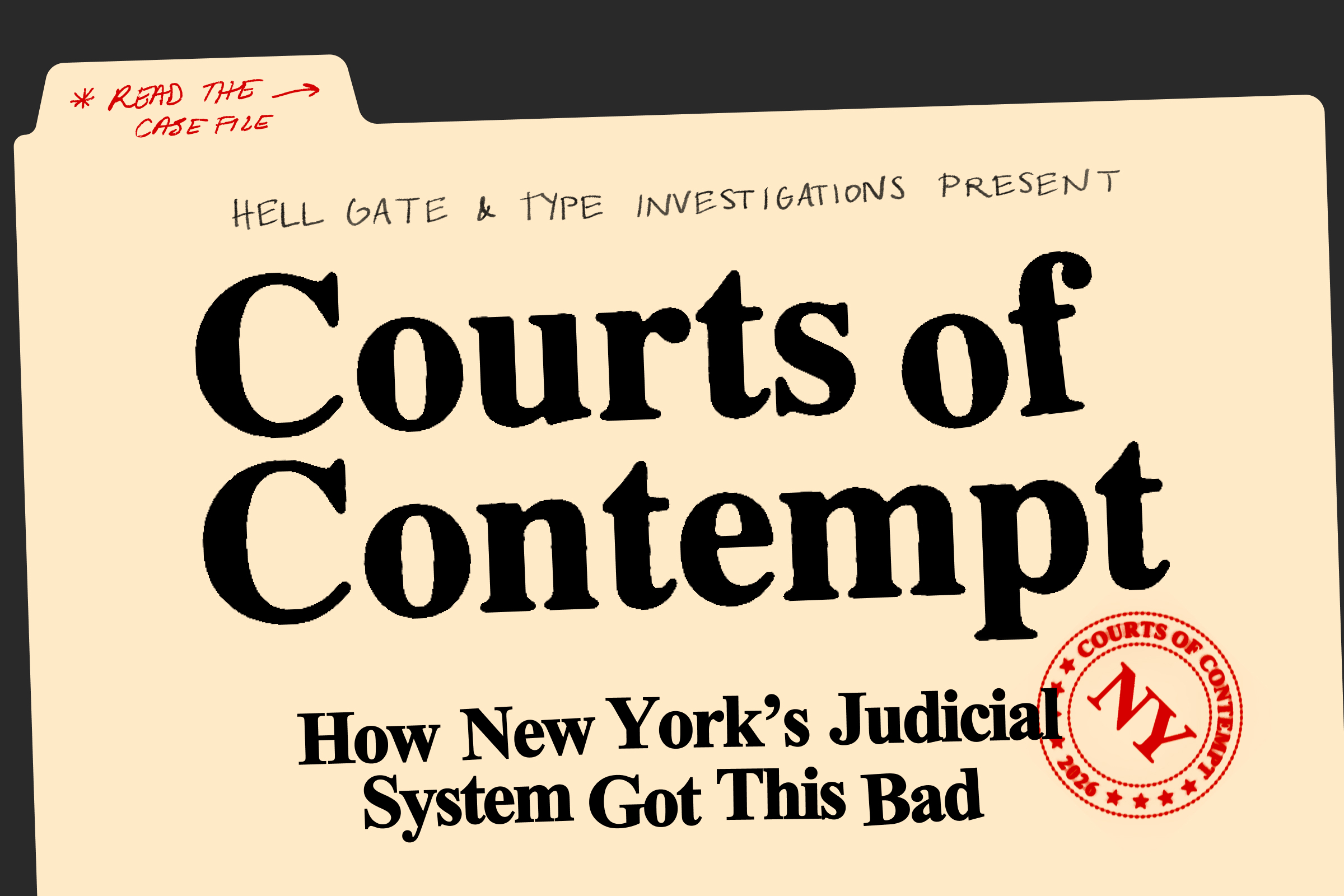
Image: Partner & Partners
Hell Gate and Type Investigations began the research for Courts of Contempt in early 2025, with the goal of shedding some much-needed light on an opaque system—the broken and scandal-plagued process by which New York City’s judges are selected. During the course of the past year, we sat in courtrooms across the city; spoke with more than 50 attorneys who practice in New York City’s courts; combed through hundreds of pages of court transcripts; interviewed more than a dozen criminal justice professors, judicial reform advocates, and good government experts; and staked out various political party events and meetings. We’re extremely grateful to the people who spoke with us and shared their stories, insights, and experiences.
A note on methodology: Courts of Contempt features profiles of nine judges who embody aspects of this broken system. We chose these nine based on responses to a survey asking about demeanor, fairness, and knowledge of the law sent to hundreds of public defenders, private attorneys, law professors, and more, as well as additional feedback from lawyers and courtwatchers. We also conducted our own research and pulled from our collective decades of experience reporting in our city’s courts. There are many judges worthy of this level of scrutiny in New York City—in fact, all judges should probably be examined in this way—and we hope others will continue to shine a light on our court system. We’ll keep watch as well.
Hell Gate is Adlan Jackson, Christopher Robbins, Esther Wang, Jessy Edwards, Julianne Escobedo Shepherd, Katie Way, Max Rivlin-Nadler, and Nick Pinto. Nadia Tykulsker is its operations and finance manager. Rick Paulas is its marketing and external relations manager. This project was edited for Hell Gate by Esther, and written by Chris, Jessy, Katie, Max, and Nick.
This project was produced in partnership with Type Investigations, with support from the Wayne Barrett Project, with editing by Aviva Shen, Nina Zweig, and Sasha Belenky, and research by Allie Conti. Our fact-checkers were Paco Alvarez, Darya Marchenkova, Paige Oamek, Nina Zweig, Rosemarie Ho, Kate Mabus, Nina Sparling, Katrina Janco, and Sophie Hurwitz.
Additional thanks to Celia Young, Ballard Spahr, and Lawyers for Reporters. The zine and website were designed by Partner & Partners. Illustrations are by Lauren Tamaki.