Fort Worth, Texas—On the last day of testimony in the federal “Prairieland” trial—wherein nine activists faced charges related to a protest outside an Immigration and Customs Enforcement detention center—the government called its star witness back to the stand. Kyle Shideler, director of counterterrorism research at the right-wing think tank Center for Security Policy, had been key to the prosecution’s case that “antifa”—the loose network of activists defined by their opposition to fascism—is a violent, criminal organization bent on overthrowing the U.S. government. Shideler, an imposing figure with a cleanly shaven head and full beard, had attended nearly the entire trial, even sitting in the overflow room during jury selection.
At the stand, Shideler read aloud the government’s definition of antifa, as well as an excerpt from President Donald Trump’s executive order declaring antifa a domestic terrorist organization—issued in September, less than two weeks after the assassination of right-wing pundit and activist Charlie Kirk. Both documents describe antifa as a shadowy, militant “enterprise” involved in “coordinated efforts to obstruct” enforcement of federal laws through “organized riots,” and in perpetrating “violent assaults” against ICE agents and law enforcement officers.
Three days later, on March 13, the jury convicted all nine defendants on a variety of charges, ranging from providing material support to terrorists to attempted murder. The ruling could have far-reaching consequences for activists, protesters and NGOs that have aligned themselves in any way with anti-fascist organizing.
But FBI records obtained by Type Investigations and In These Times through a Freedom of Information Act request contradict the government’s claim that antifa poses an existential threat to national security. And several defense attorneys involved in the trial say the information should have been included in discovery.
MarQuetta Clayton, an attorney representing Maricela Rueda—one of the defendants convicted of providing material support to terrorists, organizing a riot and conspiracy to conceal documents—confirmed that the records were not turned over.
“Coupled with some of the testimony we heard, I feel like that would all be something for the jury to decide whether it was worth anything or not,” Clayton said. “They are the tryers of credibility and fact.”
The case centered around a noise demonstration on July 4, 2025, in which roughly a dozen activists set off fireworks outside the Prairieland ICE detention center in Alvarado, Texas, about a 45-minute drive south of Dallas. Noise demonstrations are a common protest tactic, sometimes involving fireworks, whistles or megaphones, and a way of expressing solidarity with immigrant detainees or inmates who have little contact with the outside world. At least one protester spray painted a guard shack and a vehicle in the Prairieland parking lot with expletives and anti-ICE slogans and dismantled a security camera. Some of the protesters also had firearms—which in Texas, an open-carry state, is generally legal.
When a police officer arrived on scene and pulled his gun, allegedly pointing it at someone running away from him, one of the protesters fired an AR-15 style rifle in the officer’s direction. The officer was hit in the neck and suffered minor injuries. That night, and in the weeks that followed, the FBI and state law enforcement raided activists’ homes and arrested 19 people.
The shooter, Benjamin Song, a 32-year-old former U.S. Marine Corps reservist—who remained at large for 11 days—was charged with three counts of attempted murder. Other charges included organizing and carrying out a riot, providing material support to terrorists and conspiracy to use and carry an explosive. Roughly half a dozen activists not at the protest on the night of July 4 were also apprehended and charged with a variety of state and federal offenses, including one accused of conspiracy to conceal documents for moving a box of anarchist zines to a friend’s apartment. (The FBI also raided that home, using a battering ram to break through the front door and detonating a flash bang device in the living room, and confiscated all of the occupants’ phones and laptops, which have still not been returned.)
In the months since, the Prairieland case became the cornerstone of the Trump administration’s efforts to dismantle antifa and crack down on the Left more broadly. In October 2025, when the first indictment in the case was unsealed, FBI Director Kash Patel said it was the “first time” the government had arrested “Antifa-aligned anarchist violent extremists” and charged them with terrorism—despite the fact that antifa is not a formal organization and has no membership list or leadership hierarchy.
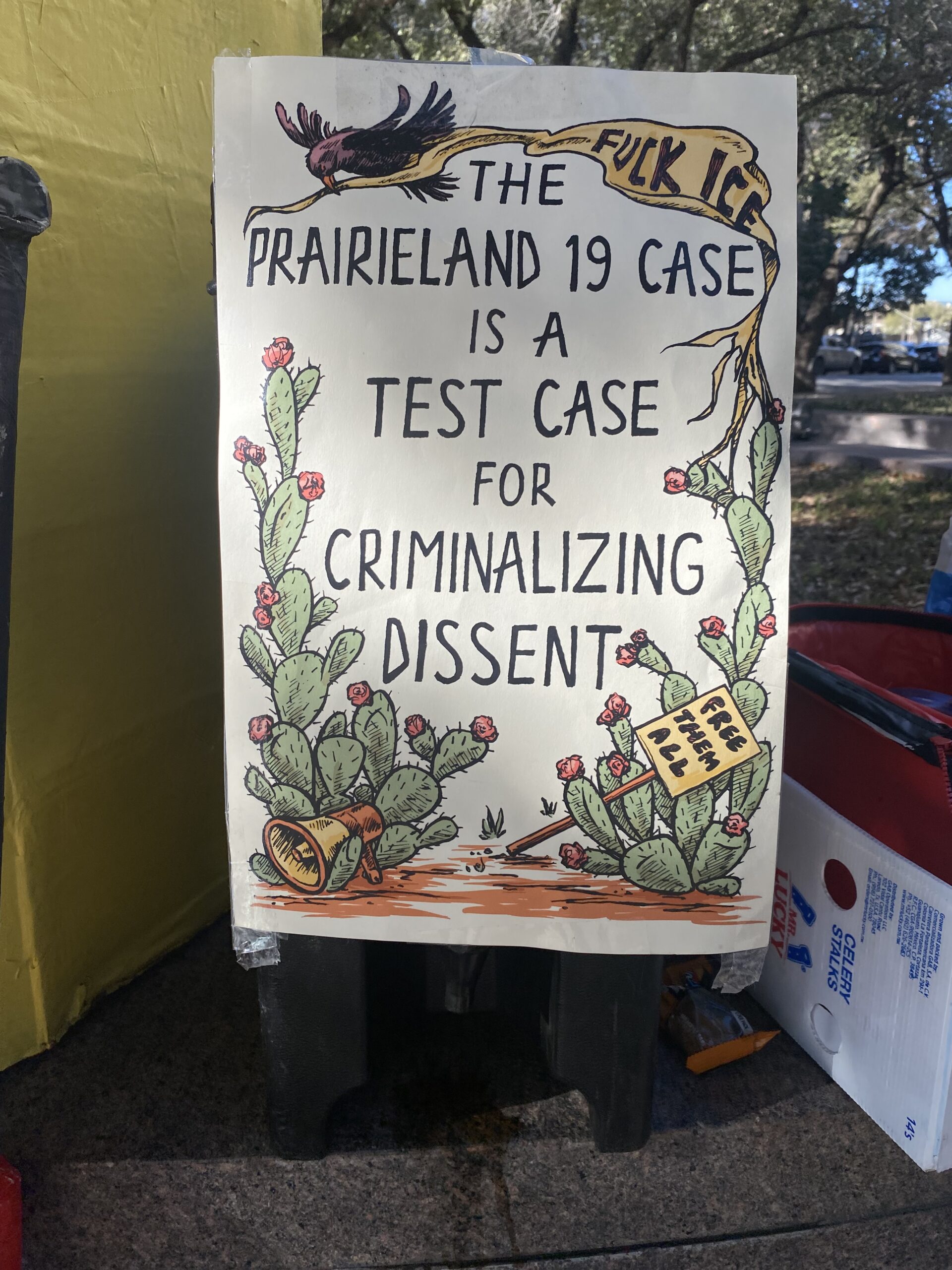
Sign included in the Support Committee’s display in Burnett Park, across from the Fort Worth, Texas, federal courthouse. Image: Adam Federman
Making that charge stick is what prosecutors set out to achieve in court. Along with the administration’s crackdown on dissent—its use of ICE agents to threaten and detain student protesters, for example—this case will likely be used to target the Left and launch investigations into anyone with connections, however tenuous, to antifa.
In a statement released a few hours after the verdict, the Department of Justice cited Shideler’s testimony and referred to the North Texas “Antifa Cell” nearly a dozen times. Attorney General Pam Bondi reiterated the administration’s claim that “Antifa is a domestic terrorist organization” and said the Prairieland case marked the beginning of a broader effort to “systematically dismantle” the group.
Shideler, asked to comment on his testimony in the hallway outside of the courtroom, told Type Investigations and In These Times, “I’m not taking any questions.”
But the government did not always consider antifa a serious threat. Records from an FBI investigation out of the Dallas field office that ended in 2018 reveal that, under Trump’s first term, the bureau had investigated “Antifa DFW” (and several allegedly related entities, including Dallas Workers Front, Dallas Antifa, Antifa Dallas, Dallas Antifascist and DFW Anti-Fascist League) and found that the group and its affiliates posed no threat to national security. This determination prompted the bureau to formally close the investigation.
“No potential criminal violations or priority threats to national security warranting further investigation were identified,” the two-page FBI file states.
The records are at odds with the case prosecutors presented during the three-week trial and indicate that, as of 2018, the top law enforcement agency in the country did not view antifa as a criminal threat. (Around the same time, the FBI also opened a case on Rose City Antifa in Portland, Oregon, suggesting that the agency’s mandate to investigate activists involved in the anti-fascist coalition extended beyond Dallas/Fort Worth. It is unclear if the Rose City investigation was closed.)
According to five defense attorneys—three of whom were involved in the federal case and two who are representing defendants facing state-level charges—this information was not included in the discovery evidence that the government provided to the defense teams.
“The prosecution broke the law when it hid this evidence from the defense,” said Texas attorney George Lobb, who is representing one defendant in the state’s case. “This internal FBI document shows the government lied about the defendants, because it presents a position contrary to what the prosecution alleged at trial. The prosecutors should be removed from this case and a new trial should be granted immediately.”
Harmony Scheurman, a defense attorney representing Elizabeth Soto—one of the activists convicted on charges of organizing a riot and providing material support to terrorists, and who was linked by prosecutors to an “Antifa DFW” X account—expressed concern that the FBI’s earlier determination had not been included.
“If we had to try it again,” she said, referring to the federal case, “we definitely would want that, since the government used that against us.”
It is standard procedure for agency investigative records to be turned over to the U.S. Attorney’s office, which then decides if a case should be prosecuted. In a phone interview, Melinda Urbina Garcia, spokesperson for the FBI’s Dallas field office, affirmed that the U.S. Attorney’s office would have been aware that this investigation had taken place, though she added that there has been turnover in the office since 2018.
“If the case was closed and no charges were brought, then obviously it is safe to say that there was a declination to prosecute,” Urbina Garcia said.
The U.S. Attorney’s Office in Texas declined to comment.
The handling of the trial by Judge Mark T. Pittman—a Trump appointee and member of the Federalist Society—raised questions from the very beginning. On day one of jury selection, Pittman declared a mistrial after learning that defense attorney MarQuetta Clayton was wearing a T-shirt featuring images of civil rights leaders under her blazer, which he called prejudicial. Pittman was also reportedly unhappy with prospective jurors’ responses to questions about ICE and law enforcement’s handling of recent protests, and subsequently called a new, smaller jury pool which he questioned himself. He also moved the trial to a smaller courtroom, prompting speculation among media that he was trying to limit press coverage.
Even before the trial began, there were concerns that Pittman—who has a reputation for sanctioning and fining defense attorneys—was trying to tip the scales. In January, Zachary Evetts, one of the defendants charged with material support for terrorism, submitted a motion for additional discovery, including any information used by law enforcement and prosecutors to conclude that the “North Texas Antifa Cell” was a “militant enterprise.” Pittman denied the request and fined Evetts’ lawyers $500 each for filing what he called “frivolous” motions. (Pittman also granted a motion filed by the government that precluded defense attorneys from making the case that the protesters may have acted in self defense, which took on greater significance when it was revealed during the trial that the officer pulled his gun first.)
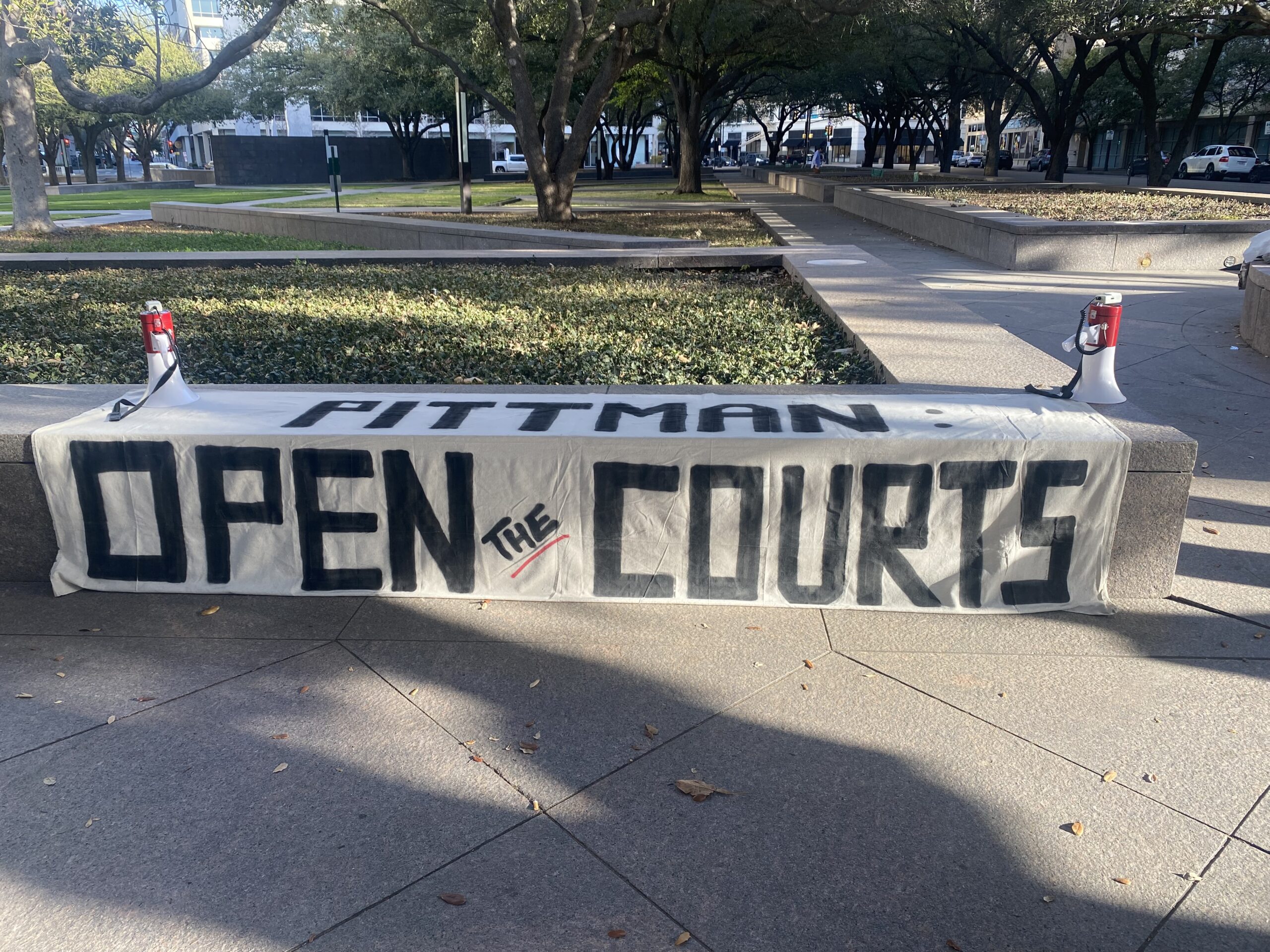
Banner criticizing Judge Mark Pittman, who moved the high-profile Prairieland trial to a smaller courtroom. Image: Adam Federman
According to their motion, lawyers for Evetts asked prosecutors multiple times about their findings that antifa posed a threat.
“There are matters in the request that I reasonably believe that you have not yet provided, but should,” Patrick McLain, Evetts’ lead defense attorney, wrote in an email to prosecutors in October.
Assistant U.S. Attorney Shawn Smith, one of the lead prosecutors, replied that they had fulfilled their discovery obligations. “The government has not identified any extraneous evidence that is not part and parcel of the charged conspiracy,” he wrote.
But during the trial, McLain told Type Investigations and In These Times, key pieces of evidence related to the events that took place on the night of July 4—including the fact that the officer was the first to pull his weapon—had not been disclosed to the defense. “We did not have evidence that they should have had and should have shared with us,” McLain said.
McLain also noted that the FBI records would be “grist for our appeal,” especially if they choose to challenge the judge’s denial of the discovery motion.
Moira Meltzer-Cohen, an attorney whose work focuses on politically motivated abuse of the legal system, and who was not part of the Prairieland case, said that evidence deemed favorable to the defense must be included in discovery. This encompasses information that could affect rulings on certain motions as well as records in the possession of law enforcement that may, in some way, undermine the charged offense. Failure to share information that could impact the outcome of the case, she said, is a violation of defendants’ constitutional rights.
“The prosecution has constitutional, common law and professional ethical obligations to disclose to defendants any ‘favorable’ evidence within the possession, custody, control or knowledge of any law enforcement personnel acting in the case,” Meltzer-Cohen said.
It’s fair to say that a prior FBI investigation finding that “Dallas Antifa” in fact posed no threat to national security would fit in that category.
Mike German, a former FBI special agent and author of the 2019 book Disrupt, Discredit, and Divide: How the New FBI Damages Democracy, said the 2018 records appear “to contradict the prosecution’s argument that common tactics of anti-fascist protesters are evidence of criminal intent.” He added that the FBI files, along with the underlying investigation, “should have been disclosed so the defense could properly challenge the factual basis of [the] prosecution’s theory.”
The government’s case relied in part on the perception that wearing black clothing to a protest, communicating via encrypted texting app Signal and reading anarchist or anti-fascist literature was part of a wider conspiracy to ambush and attack law enforcement. Or as the Trump administration would have it, to overthrow the government.
German acknowledged that the FBI’s assessment of Dallas Antifa could have changed since the 2018 investigation was closed. If that were the case, though, he suggested that a more comprehensive account of law enforcement’s opinion of antifa should have been aired in court—particularly in a trial that featured testimony from several FBI agents.
David Rudovsky, a civil rights attorney and senior fellow at the University of Pennsylvania’s Law School, who was not involved in the trial, said there is no question the records should have been included in discovery.
“It goes to the core of what the government was saying,” Rudovsky said, noting that while the agency’s views could have changed since 2018, the FBI files still offer a rebuttal to the expert witness’s theory of the case. “To deprive the defense of that, I think, is to deprive them of some pretty core Brady material,” he added, referring to a 1963 Supreme Court case which compels the prosecution to turn over any evidence that might be considered exculpatory or favorable to the defense.
Trump’s DOJ, particularly during his second term, has repeatedly flouted or ignored judicial orders, misrepresented evidence and taken actions deemed to be “arbitrary and capricious,” generally undermining public trust in the rule of law, in the assessment of non-partisan law and policy journal Just Security. According to an ongoing project spearheaded by the journal, there have been more than 120 rulings since 2025 in which courts have expressed distrust of government information and representations, and have not complied with discovery orders.
The FOIA records obtained for this story are just a small portion of the documents related to the 2018 Antifa DFW investigation. According to the government, in a pending lawsuit brought by this author against the FBI, the agency possesses up to 250 pages of documents that have not been previously released.
When word of the verdict reached family and friends, members of the Prairieland support committee and activists gathered outside of the courtroom on the afternoon of Friday, March 13, there was a palpable sense of shock and disbelief. A smaller group of committee members began drafting a media response. Local television crews lined up outside of the main entrance. Tensions were high.
Joseph Fabbro, an activist working with Fire Ant Movement Defense, who’d come from out of state to help with defense strategy and messaging, said the group had mapped out responses to four potential outcomes. But guilty verdicts on nearly all charges was not one they had accounted for. And Fabbro said the convictions—particularly on material support for terrorism—set a dangerous precedent.
The first Trump administration, Fabbro pointed out, went after the so-called J20 protesters, who’d staged a rally in Washington, D.C., on inauguration day 2017, alleging that they were part of a conspiracy to riot. But the charges were dismissed. State officials in Atlanta have also leveled RICO charges—originally conceived to target organized crime—against activists seeking to stop the construction of a police training facility known as Cop City. Those, too, have failed.
The Prairieland trial marks a turning point.
“Now they have succeeded at making dressing in black together—at the very least in these specific circumstances—a felony: providing material support for terrorism,” Fabbro said. “They’re saying that’s the same thing as me giving bitcoin money to Al Qaeda, which is simply absurd.”
“This case was overcharged,” said Lesa Pamplin, an attorney who was part of Maricela Rueda’s defense team. “This is not a riot compared to January 6. This was brought because Trump wanted it brought.”
But the fate of the Prairieland defendants—and the five protesters who pleaded guilty and cooperated with the government—is far from over. Many still face state-level charges. (Johnson County prosecutor Christy May was present during most of the federal trial.) And appeals and challenges in the federal case will likely come after defendants are sentenced in June.
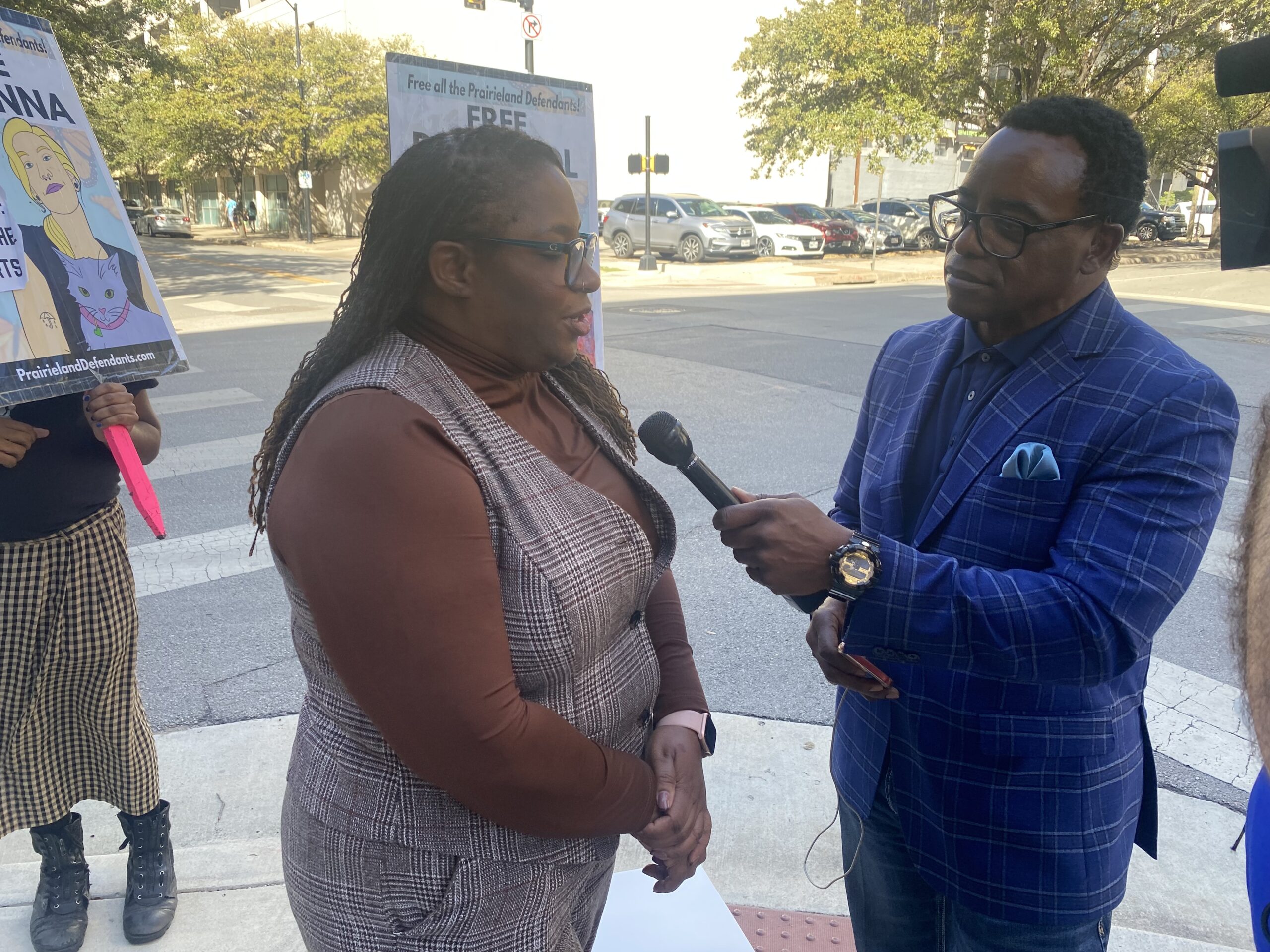
Maricela Rueda’s defense attorney, MarQuetta Clayton, speaks to local media after the jury delivered its verdict on March 13. Image: Adam Federman
George Lobb, the Texas attorney representing one defendant on state charges, said the Johnson County District Attorney’s office has told him it has over 20 terabytes of evidence—likely a mix of video, photographs and thousands of pages of files—in discovery but have not turned any of it over.
“We are quickly approaching the one-year anniversary of this case and none of that has been provided,” Lobb said, adding that it could be a violation of his client’s speedy trial rights.
Xavier T. de Janon, the National Lawyers Guild director of mass defense and a member of the People’s Law Collective, who is also representing a defendant in the state case, said the 2018 FBI records raise troubling questions about the prosecution’s handling of evidence in the trial and also undermine Shideler’s testimony. De Janon said that if the state-level case proceeds, he will be requesting records related to the earlier FBI investigation, which he noted could also have implications for the federal case when appeals are filed.
“If the FBI already concluded years ago that there was no criminal concern to DFW Antifa, why didn’t that come up during the federal trial?” de Janon asked. “Did federal prosecutors even know this investigation had happened?”